


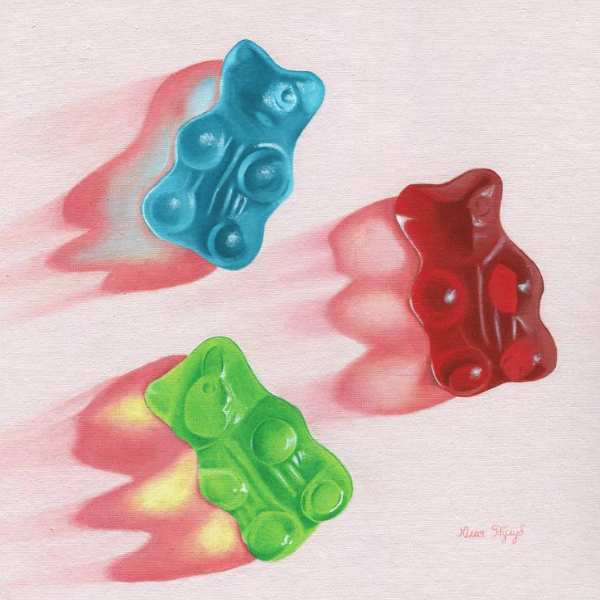
This morning, I noticed a three-year-old girl completely immersed in a little bag of Haribo.
She studied each sweet with extraordinary concentration, selecting one colour at a time before returning her hand to the packet with the seriousness of someone making a consequential decision.
Watching her, memories came flooding back, and I found myself thinking that Haribo must be one of the most lovable brands in the world.
Its genius lies in its ability to appeal instantly to a three-year-old while carrying decades of emotional memory for the adult standing beside her: to be discovered for the first time and remembered all over again.
The company was founded in Bonn in 1920 by the German confectioner Hans Riegel. Its name was formed from
HAns
RIegel
BOnn.
What sounds today like a joyful invented word began as a practical abbreviation of a founder and a place.
Riegel started producing sweets in a small kitchen with a copper kettle, a marble slab, a stove and a sack of sugar. His wife, Gertrud, became the company’s first employee and delivered orders by bicycle.
In 1922, he created the Dancing Bear, inspired by the trained bears once seen at European fairs. Taller and slimmer than the gummy bear we know today, it already contained the idea that would shape the brand: the sweet was a character as much as a confection.
Over time, the Dancing Bear became the Goldbear, smaller, rounder, softer and more childlike. Haribo had created an object people could recognise, hold, exchange and remember.
Its visual language is immediate: the bold red wordmark, bright yellow, transparent packaging, the smiling bear and the vivid colours of the sweets themselves.
The rounded letters echo the soft forms inside the bag. The colours suggest flavour before the packet is opened.
The yellow bear, wearing his red bow tie, gives the brand its host, welcoming us into a familiar world of colour and pleasure.
The character and packaging have evolved over the years, but never so much that they lose their familiarity. Haribo understands that recognition is one of a brand’s most valuable assets.
Perhaps the clearest measure of Haribo’s reach is that the gummy bear no longer needs the packet. It has slipped into contemporary visual culture, appearing in paintings, sculpture and collectible art, including an entire category of works on Saatchi Art. Few confectionery brands achieve that kind of independence from the product itself. Haribo made a sweet so visually complete that it became an object, an icon and, eventually, material for artists.
Its long-running slogan captures the idea perfectly:
Haribo makes children happy and adults as well.
The company has protected the elements people love: its name, its red logo, its bear, its colours and, above all, the shape of the Goldbear itself.
The gummy bear has no language, no nationality and almost no barrier to understanding. It invites selection, sorting, sharing and ritual. Some choose by colour. Some save their favourite flavour until last. Some bite off the ears or feet. Others eat several at once.
Watching that little girl disappear into her bag of Haribo, I realised that the brand’s greatest achievement is not simply that it has endured for more than a century.
It is that, after all that time, the experience still feels entirely personal.
